


 View Profile
 View Forum Posts
 Private Message


There is of course also the option:Originally Posted by Kong
Regular VCR + [one of those DVD recorders mentioned in this thread] and a decent USB capture device.
Assuming there is a good working USB capture solution/chain on the MAC
+ Reply to Thread
Results 91 to 101 of 101
-
Last edited by The_Doman; 30th Jul 2026 at 15:48.
-
D8 cameras have TBC. Do yours have it and if it works good you need to check or search the internet.Originally Posted by Kong
The easiest way would be to look for someone who has FireWire, rip a snippet of that tape you have, and check it out.
If the result is OK, then you have the problem out of your head.
If the result is bad and waviness still occur, you need a passthrough device with TBC (Panasonic DMR-EH5x), between the VCR and the D8 camera. Or buy a grabber and use it instead of a camera. -
Where do you see the need for de-block (attachment)?Originally Posted by lollo
1. You capture in YUV420, encode in YUV420 and see a problem somewhere?3. It is the opposite, because 4:2:0 reduces color resolution both horizontally and vertically (by half in both directions).
This can be problematic for formats that already have little color information such as VHS and S-VHS, as the chrominance is further reduced. Pratically 4:2:0 is taking away color from a signal that already has very little of it causing blurred colored edges, color bleeding, aliasing, loss of fine saturation and banding.
Of course with poor sources the difference is minimal, but for nice VHS and S-VHS is not so small. Strange, because with luma 16-235 on the input and output it doesn't bother you The human eye is more sensitive to luma than chroma.
2. More damage than the YUV420 on the input is done by JVC with his "temporal smoothing".Last edited by rgr; 30th Jul 2026 at 16:22.
-
Sure!Originally Posted by rgr
Originally Posted by rgr

The gaps and spikes in the histogram is another story, charlatan, and not all grabbers feature that.Originally Posted by rgr
Tell me now that you capture in 4:2:0, which is a loss, but in 10 bits, which is completely useless.Originally Posted by rgr
I have a different opinion about who is not understanding, but I do not care at all.Originally Posted by rgr
-
Do you expect me to loose time checking your videos? DV introduces blocks by default and by the law of physics and maths; if there is a sample with minimal artifacts is not the rule (the same as per your crap experiment).Originally Posted by rgr
We keep the luma and the chroma as there are on tape. There is not need to deteriorate chroma more.Originally Posted by rgr
The rest about levels and sensitivity is absolutely out of contest.
That's the last of your bullshit.Originally Posted by rgr
While a temporal noise reduction is present, is not worst than what youobtain with a temporal denoiser avisynth filter with high temporal radius. If the starting point is cleaner, there is less need to use strong settings. And the final result is equivalent.
JVCs are wonderful machines (not all of them of course). Once more look to real examples of mine comparing a signal dumped directly from a satellite stream and its brother who has been recorded by a JVC on a tape and then captured. No difference, which validate the full chain! -
Heh, it's supposed to be simple subtraction, but you couldn't do itOriginally Posted by lollo
-
It is not a question of subtraction, but of impactOriginally Posted by rgr
To OP: I apologize for this off topic, but this charlatan needed to be corrected. My last post on this thread, I promise. -
You could use some for training, because you're already pushing harsh nonsense, Dr. Professor of TheoryOriginally Posted by lollo
Civil courage a little, show these blocks.
Dr. Associate Professor of Theory, there are no bytes on the tape, there are voltsOriginally Posted by rgr
It's such an analog monster! The more precisely you sample it, the better the reproduction you'll get.
Well, I seeThat's the last of your bullshit.Originally Posted by rgr
While a temporal noise reduction is present, is not worst than what youobtain with a temporal denoiser avisynth filter with high temporal radius. If the starting point is cleaner, there is less need to use strong settings. And the final result is equivalent.
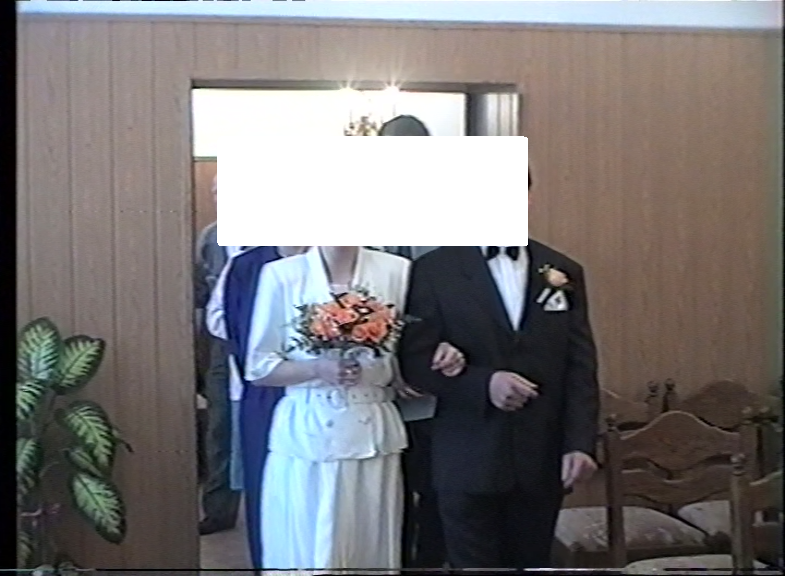

The frame from JVC is the one below...JVCs are wonderful machines (not all of them of course)
Even the YUV444P16 wouldn't help here, but the good news is that no YUV will hurt more... -
You need that DVD recorder before your HV30 (the HV30 does not do any stabilising according to my test).Originally Posted by Kong
For a better result, instead of American (4.1.1 colour) Firewire, go the lossless route, capture with a USB digitiser such as the GV-USB2, USB-Live2 or 710-USB (although the 710 doesn't work on Win 10 or 11 here). Then edit your files with Premiere (what format AVIs does it accept?). The lossless process is more complex than the DV route.
So, get your hands on a suggested DVD recorder, do a HV30 capture and assess. Looks good? Stick with that. Not happy, or feeling a bit nerdy, move up to the lossless route. -
Well, my sturdy JVC HR-S9500 smoothes the picture even when disabling all of its internal filters (which can be disabled by the user), and some of the details (like fine vertical structures) cannot be recovered in post. For this reason I prefer my Pana NV-HS860 for capturing. It captures more details (provided these are on the tape) and more noise, but the details are preserved after denoising in post.Originally Posted by lollo
It may be more prominent for home videos than for preprocessed broadcast or commercial tape material though.
Apologies for adding to the off-topic stuff
Last edited by Sharc; 31st Jul 2026 at 03:18.
-
In my case is the opposite because the JVC is better than the Panasonic, and I posted a comparison in the forum some time ago. Cannot find it now.
Sorry, re-end of the off-topic
 Quote
Quote


Similar Threads
-
Newbie VHS Digitizing
By Darwin4Ever in forum Newbie / General discussionsReplies: 9Last Post: 4th Jan 2025, 09:00 -
How Do You Recycle VHS Cassettes
By Subtitles in forum MediaReplies: 6Last Post: 16th Dec 2024, 14:17 -
Digitizing homemade VHS videos
By tomini in forum Newbie / General discussionsReplies: 19Last Post: 9th Dec 2023, 20:06 -
Getting started digitizing VHS collection
By planetearth in forum Newbie / General discussionsReplies: 6Last Post: 28th Nov 2023, 10:26 -
I need help with color flickering digitizing my VHS tapes
By HansensUniverse in forum Capturing and VCRReplies: 2Last Post: 1st Feb 2022, 05:08